Pearson Edexcel · A-Level · Economics B
Course version: 9EB0 · Version from Sept 2015
Quantitative skills: QS 2: calculate, use and understand percentages,…
Full specification wording
Appendix 3: Quantitative skills: QS 2: calculate, use and understand percentages, percentage changes and percentage point changes
Percentages, percentage changes, and percentage point changes are vital for analysing economic data over time.
Checked against the Pearson Edexcel 9EB0 specification (opens in a new tab) on .
- Point 2 of 7
- 3 key terms
Study notes
From the checked teaching notes for this specification point.
The idea
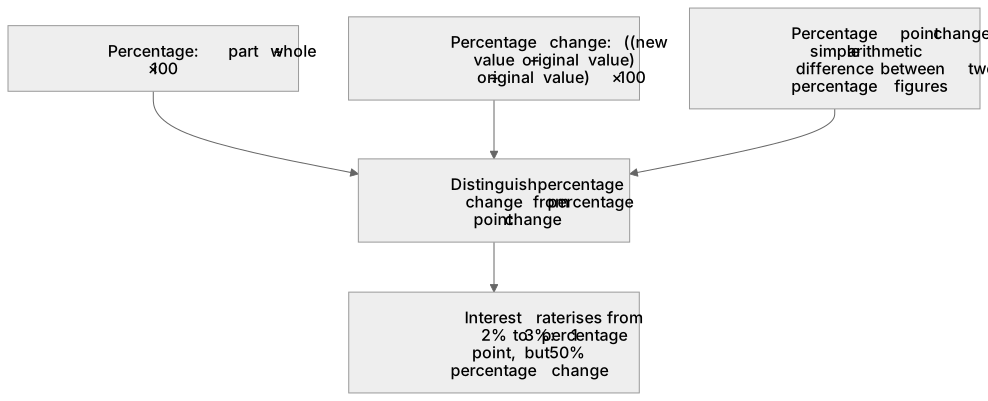
Percentages, percentage changes, and percentage point changes are vital for analysing economic data over time. A percentage expresses a fraction of 100, useful for market share or interest rates. Percentage change calculates the relative change between two values: ((new value - original value) / original value) x 100. For example, if a price rises from £50 to £60, the change is ((60 - 50) / 50) x 100 = 20%. A percentage point change measures the absolute difference between two percentages. If an interest rate increases from 2% to 3%, it has risen by 1 percentage point, but the percentage change is 50%. You must calculate, use, and understand these distinctions to accurately interpret inflation, growth, and policy impacts.
What earns the marks
- Calculate a percentage by dividing the part by the whole and multiplying by 100.
- Calculate percentage change using the formula: ((new value - original value) / original value) x 100.
- Calculate percentage point changes by finding the simple arithmetic difference between two percentage figures.
- Interpret the economic significance of these calculations, such as distinguishing between a fall in the rate of inflation and a fall in the price level.
Common mistakes and how to put them right
Confusing percentage change with percentage point change.
Put it right: Use percentage points for the absolute difference between two percentages, and percentage change for the relative difference.
Dividing by the new value instead of the original value when calculating percentage change.
Put it right: Ensure the denominator is the original (or older) value.
Misinterpreting a negative percentage change as a negative absolute value.
Put it right: Recognise that a negative percentage change simply indicates a decrease from the original value, not necessarily a value below zero.
Exam tips
- Clearly state whether your final answer is a percentage (%) or in percentage points (pp) to avoid losing accuracy marks.
- When analysing inflation or economic growth data, pay close attention to whether the data shows the rate of change or the absolute index value.
- Always show your working for percentage change calculations, as you may earn method marks even if the final answer is incorrect.
Try the lesson
The start of the Appendix 3: Quantitative skills: QS 2: calculate, use and understand percentages, percentage changes and percentage point changes lesson, made from checked teaching notes for this specification point.
Have a go first
A retail store reduces the price of a television by 15% during a seasonal sale. If the original price of the television was £800, what is the new sale price?
Listen
Percentages, percentage changes, and percentage point changes are vital for analysing economic data over time. A percentage expresses a fraction of 100, useful for market share or interest rates. Percentage change calculates the relative change between two values: ((new value - original value) / original value) x 100. For example, if a price rises from £50 to £60, the change is ((60 - 50) / 50) x 100 = 20%. A percentage point change measures the absolute difference between two percentages. If an interest rate increases from 2% to 3%, it has risen by 1 percentage point, but the percentage change is 50%. You must calculate, use, and understand these distinctions to accurately interpret inflation, growth, and policy impacts. A strong answer earns marks for these points. Calculate a percentage by dividing the part by the whole and multiplying by 100. Calculate percentage change using the formula: ((new value - original value) / original value) x 100. Calculate percentage point changes by finding the simple arithmetic difference between two percentage figures. Interpret the economic significance of these calculations, such as distinguishing between a fall in the rate of inflation and a fall in the price level. A common slip: Confusing percentage change with percentage point change. Instead, use percentage points for the absolute difference between two percentages, and percentage change for the relative difference. Exam tip: Clearly state whether your final answer is a percentage (%) or in percentage points (pp) to avoid losing accuracy marks.
See it
Key words
Say what each word means before you turn the card.
Percentage
Try answering aloud or in your head before turning the card.
Percentage change
Try answering aloud or in your head before turning the card.
Percentage point change
Try answering aloud or in your head before turning the card.
See every definition
- Percentage
- A fraction of 100, useful for market share or interest rates, calculated by dividing the part by the whole and multiplying by 100.
- Percentage change
- The relative change between two values, calculated as ((new value - original value) / original value) x 100.
- Percentage point change
- The absolute difference between two percentages, found by the simple arithmetic difference between two percentage figures.
Label the diagram
Some boxes have lost their names. Pick the right name for each number.
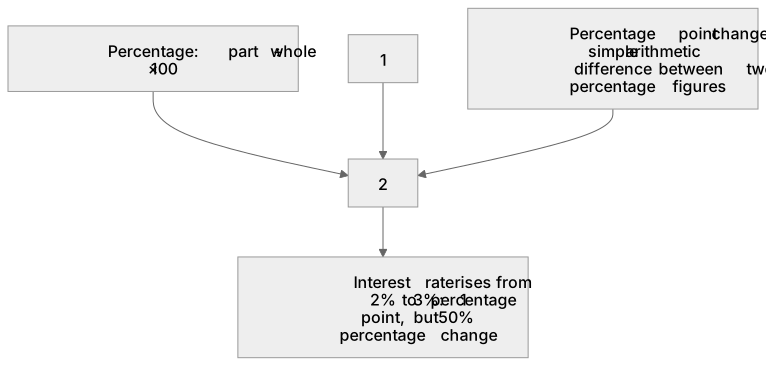
1Box 1
2Box 2
There is more to this lesson
The full lesson goes on to check your understanding and help you earn the marks. Create a free account to carry on, with your progress saved.
A week of Premium from your first lesson · Then the free plan continues · No card, no charge
Test your understanding of Appendix 3: Quantitative skills: QS 2: calculate, use and understand percentages, percentage changes and percentage point changes
Active recall beats re-reading. Take an instant quiz now to test what you’ve learned and lock it into long-term memory.
A week of Premium from your first lesson · Then the free plan continues · No card, no charge